Jump to a section
The short version
Custom plush toys are stuffed soft toys manufactured to your own design — a character, mascot, animal, brand IP or product — rather than bought from a factory's existing catalogue. A full-production order moves through nine stages (design intake → pattern → sample → materials → cutting → sewing → stuffing → QC → packing), usually takes 45–95 days door to door, and is priced mainly by quantity: a typical 12 inch/30 cm character runs roughly US$7–12 per piece at a 500-piece minimum, falling to US$2.50–4.50 at 10,000+ pieces. If the toy is for children aged 12 or under and sold in the US, or sold in the EU/UK, it must be tested and certified to the local toy-safety standard before it reaches retail.
What are custom plush toys?
A custom plush toy (also called a custom stuffed animal, custom plushie or custom soft toy) is a sewn, fabric-and-stuffing toy built from your design. Instead of choosing a ready-made bear from a catalogue, you supply artwork, a character sheet, a reference sample or even a photo, and the factory develops a sewing pattern, makes a physical prototype, and then mass-produces the approved design with your choice of fabric, colours, filling, face, accessories, labels and packaging.
It is one of the most flexible physical products a brand can make. The same factory floor can turn out realistic animals, chibi anime characters, cotton dolls, plush keychains, corporate mascots, seasonal gifts and licensed merchandise. Demand is growing with it: industry analyst Grand View Research sized the global stuffed-animal and plush-toy market at about US$13.68 billion in 2025 and projects around US$25.94 billion by 2033, an 8.4% CAGR, led by licensed and character-based products, adult collectibles and gifting, according to Grand View Research (corroborated by Research and Markets). A large share of that volume is manufactured in China, concentrated in the Guangdong–Dongguan toy cluster where our own factory operates.
Who orders custom plush toys?
Most of the projects on our floor fall into one of these groups — if you recognise yourself here, this guide is written for you:
- IP, anime, game and entertainment brands turning characters into collectible plush, cotton dolls and designer toys.
- Independent artists, illustrators and crowdfunding creators (Kickstarter, Indiegogo, creator shops) launching their first character line.
- Promotional and brand-merch teams needing mascots, event giveaways, influencer kits and retail-ready campaigns.
- E-commerce sellers, retailers and distributors building private-label plush for Amazon, Shopify, boutique chains and gift shops.
- Zoos, museums, schools, sports clubs and tourism brands creating signature animal and mascot souvenirs.
- Baby, kids and lifestyle brands adding comforters, rattles, nursery plush and weighted soft toys.
Types of custom plush toys you can make
"Custom plush" covers a surprisingly wide family. The construction, cost and safety rules differ between them, so it helps to name exactly which product you want in your first email. These are the categories we develop most often.
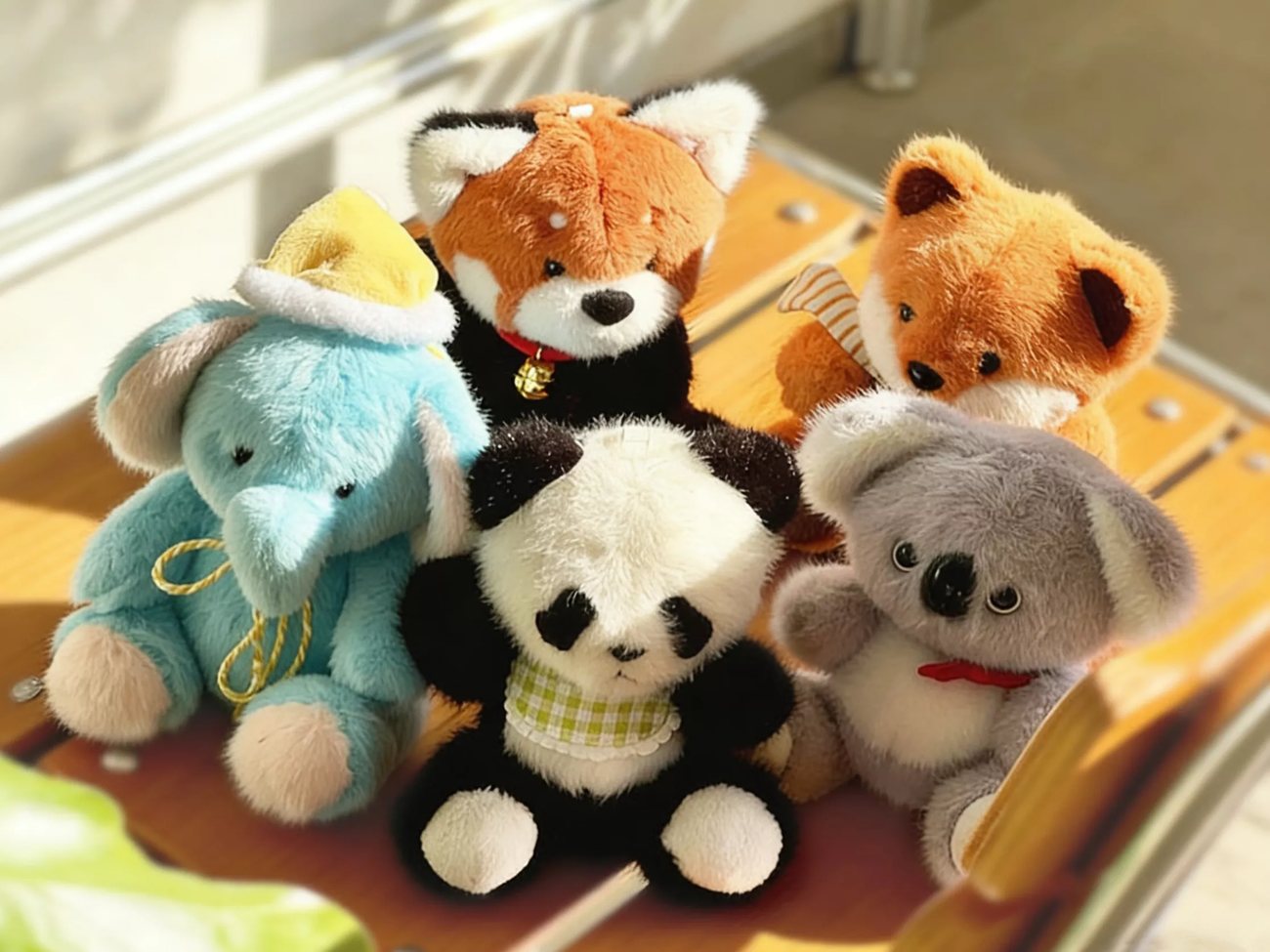
Animals & realistic plush
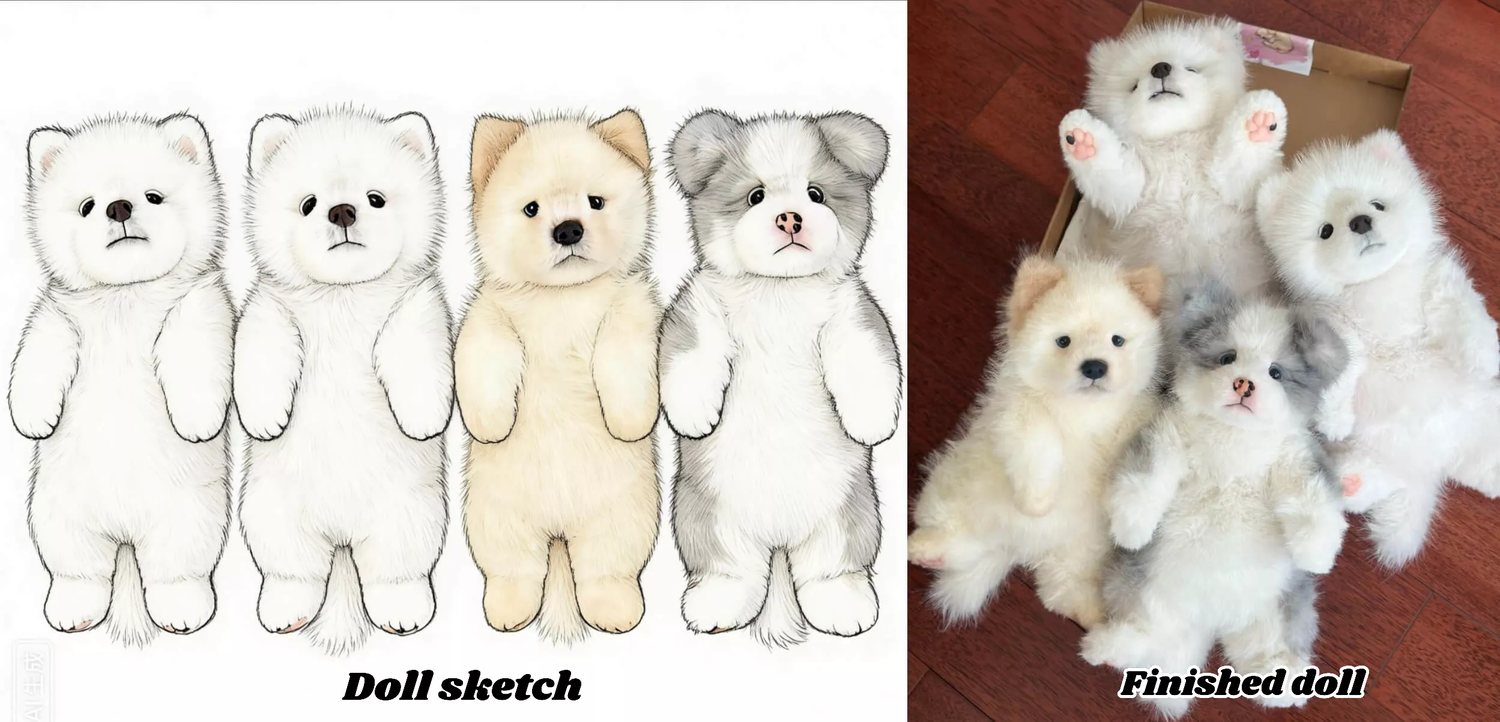
Bears, dogs, wildlife, dinosaurs and breed-specific pets in stylised or near-realistic proportions. Realism depends on patterned fabric panels, airbrushed shading, sculpted muzzles and careful stuffing density — the puppy series below was developed from a single front sketch into four distinct breeds.
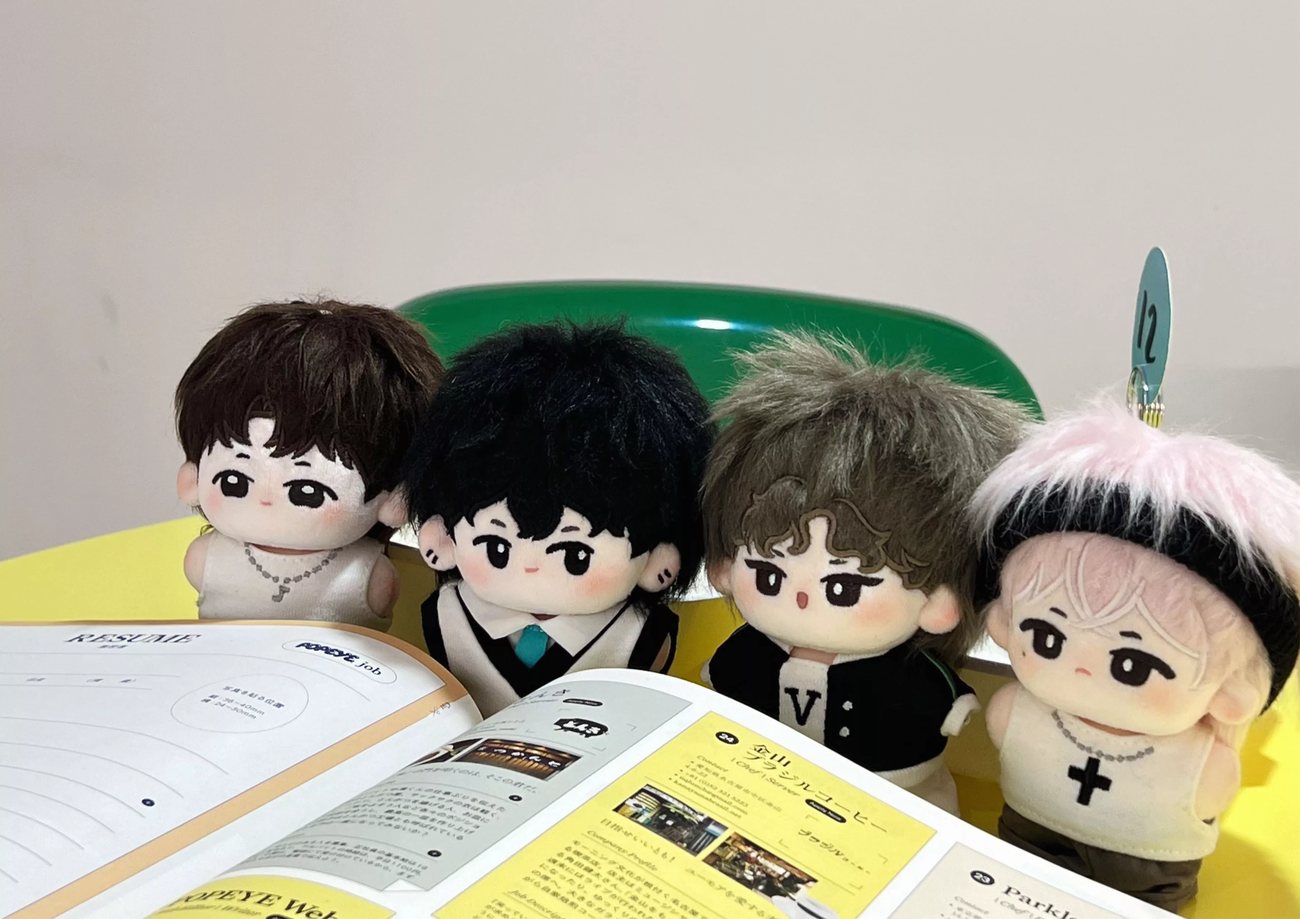
Character plush & cotton dolls
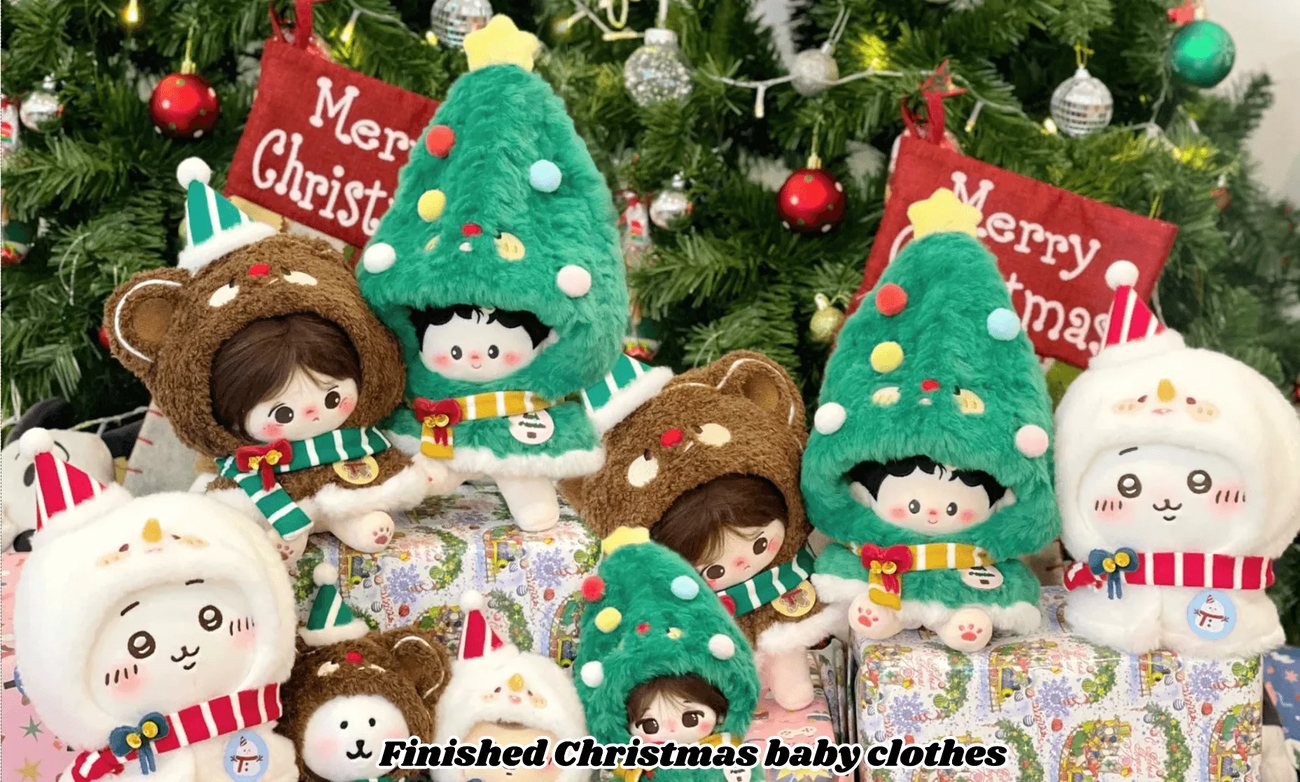
Chibi and anime characters, idol cotton dolls (棉花宜宜), and licensed IP figures with embroidered faces, rooted or plush hair, and removable costumes. This is our most detail-driven work: facial proportions and embroidery are refined over several sample rounds until the character reads correctly.
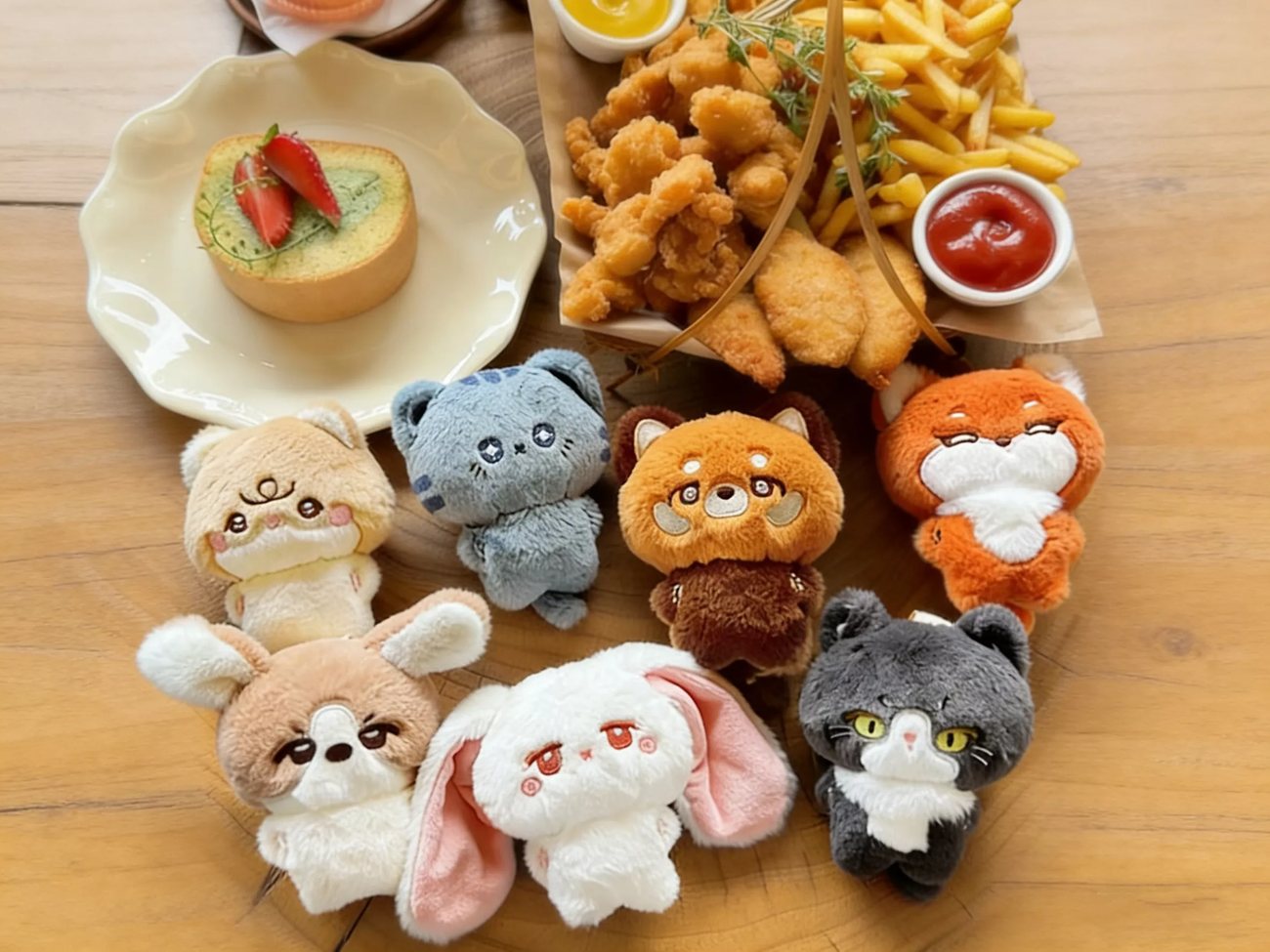
Plush keychains, bag charms & mini plush
Palm-sized characters with keyrings, lobster clasps, lanyards or suction cups — high-margin add-ons, blind-box items and gachapon merchandise. Small parts and hardware mean age grading and pull-testing are specified up front.
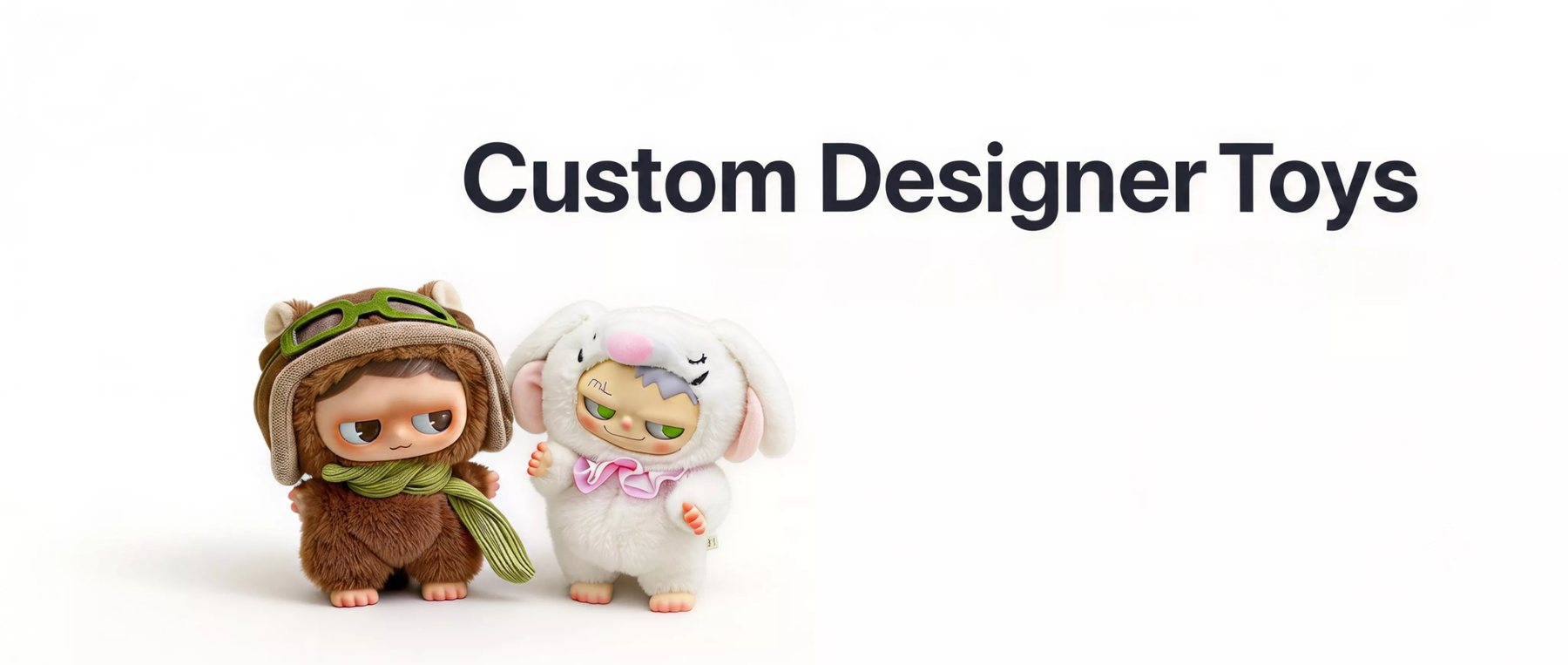
Designer plush & mixed-material figures
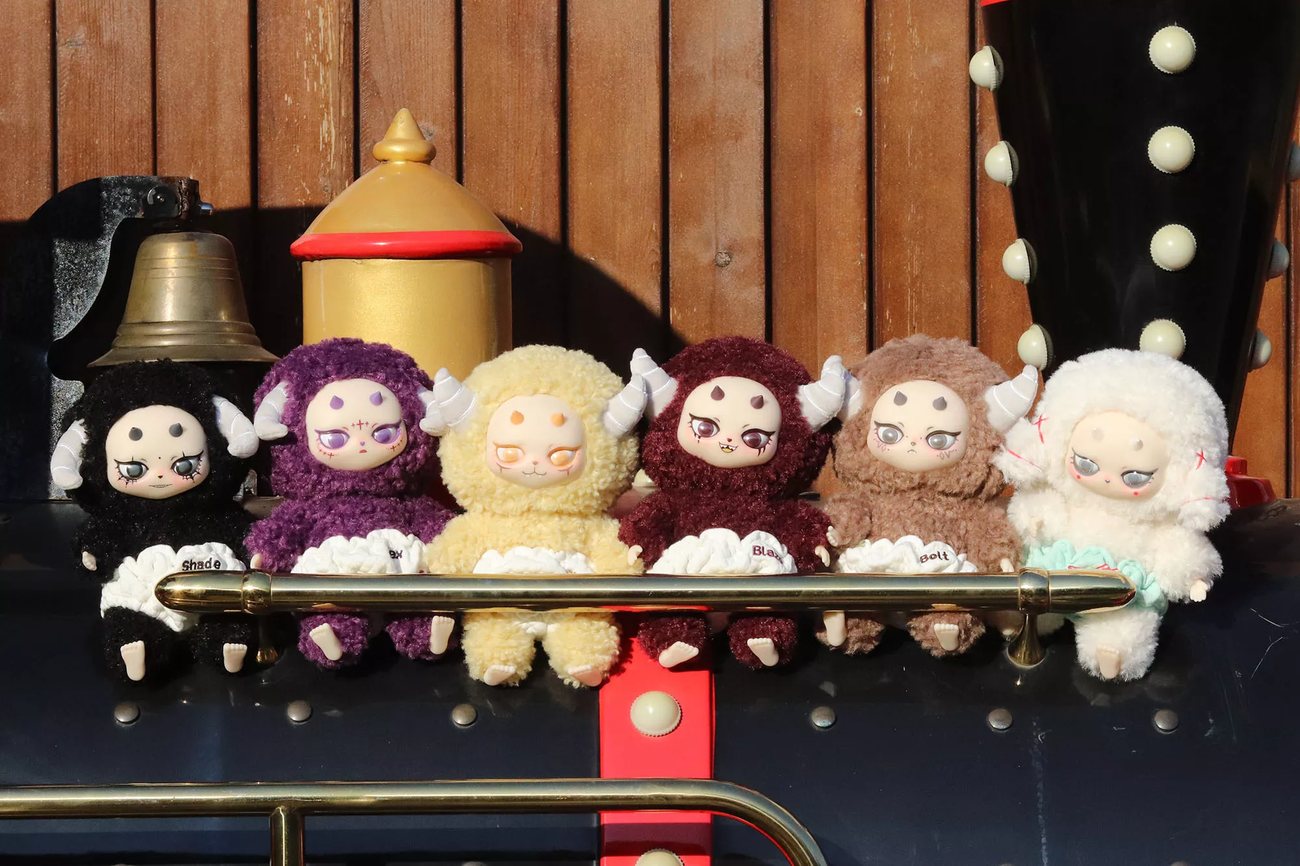
Plush bodies combined with vinyl, PVC or silicone faces and hands, dressed costumes, hats and accessories — the "designer toy" look popular in collectible culture. These projects combine a soft-toy production line with moulded-part tooling, so they need a slightly longer sampling stage.
Materials, decoration and customization options
The single biggest cause of disappointing samples is a vague spec. "Soft and cute" is not a material. Here is the option list we quote from — you do not need to know the exact fabric name (we recommend based on your reference), but pinning these down before sampling avoids rework.
Shell fabrics
- Short plush / velboa — the workhorse pile for most toys; smooth, durable, holds embroidery well and comes in every colour.
- Minky / micro-fleece — ultra-soft, low-pile and slightly stretchy; popular for baby products and premium dolls.
- Boa / long-pile fleece — fluffy, shaggy texture for teddy bears, llamas and furry characters; pile direction must be planned in the pattern.
- Knitted, ribbed, satin, denim and printed cloth — used for clothing, ears, paws and special textures; custom-printed or custom-dyed to Pantone.
Filling, weight and structure
- PP cotton (polyester fibre) — the standard soft, resilient, wash-safe fill; recycled rPET fibre is available on request for sustainability programs.
- PE / PP pellets ("beans") — sealed inside an inner pouch to give bottoms and paws weight and a slumped, huggable sit; pellets must be double-bagged for under-3 products.
- Internal structure — armature wire for poseable limbs, plastic joints for turning heads/limbs, crinkle paper, rattles or squeakers for baby toys, and weighted discs in sealed pouches.
Faces and decoration
Faces are almost always embroidered while the fabric panel is still flat, on multi-head computerised embroidery machines — it is more precise, symmetrical and child-safe than adding parts after assembly. Other options:
- Embroidery — eyes, mouths, blush, logos and fine detail; the default for toys intended for children under 3.
- Appliqué — fabric shapes stitched on for bellies, muzzles and patches.
- Safety eyes / noses — locked plastic washers; not suitable for under-3s without secure construction and testing.
- Printing — screen print, heat transfer and dye sublimation for complex gradients, all-over patterns and photo-style art.
- Moulded faces — vinyl/PVC/silicone parts for designer toys, produced from tooling.
| Component | Common options | Notes for buyers |
|---|---|---|
| Size | 5–15 cm charms; 20–40 cm standard; 50 cm+ jumbo | State standing vs seated height — they differ. |
| Colours | Stock colours or custom Pantone / TPX match | Custom dye adds a per-colour fee and a few days. |
| Clothing & accessories | Removable outfits, hats, scarves, bags, magnets, hangers | Removable clothing is a separate pattern — budget sample time. |
| Branding | Woven / printed label, embroidered logo, heat-stamp, hangtag | Woven labels need a small setup fee; send vector art. |
| Packaging | Polybag, header card, OPP bag, color box, gift box, custom master carton | Retail packaging affects carton count, freight and testing. |
| Eco options | rPET fill and fabric, recycled plastics, FSC boxes | Ask early; availability varies by material. |
The factory recommends the material combination; you approve it at the sample stage before any bulk fabric is ordered.
From drawing to plush: what to send
You do not need a finished technical drawing. Most projects start with a single illustration and a conversation. The pattern maker's job is to translate a 2D character into a set of flat fabric panels that, sewn and stuffed, recreate the 3D form. A complex 30 cm character can require 18–30 separate panels, so the clearer the reference, the closer the first sample lands.
Ideally send: a front view (and side/back view if the design has them), a size in centimetres, target quantity, colour references (Pantone if possible), any reference photos of texture or proportions, accessory and clothing notes, the intended age group and sales market, and your deadline. AI-generated concept art, hand sketches, mascot logos and photos of an existing sample all work as starting points.
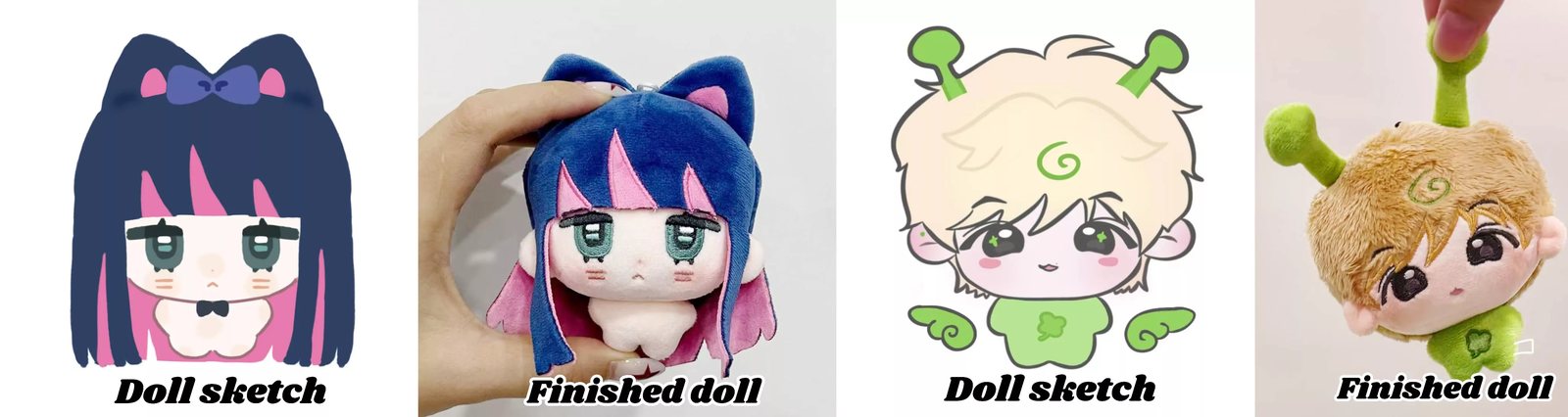
Two things consistently surprise first-time buyers. First, some designs cannot be made exactly as drawn — a feature that works in 2D may need an internal wire, a printed panel instead of embroidery, or a small proportion change to sit correctly once stuffed. A good factory flags this in a feasibility note before quoting, not after you have paid for a sample. Second, the face is the product: most revision rounds are about eye placement, embroidery density and expression, which is why faces are embroidered first and reviewed carefully.
How custom plush toys are made: the 9-step process
This is the exact workflow on our Dongguan floor, from a buyer's first email to export cartons. Knowing the stages makes quotes and lead times far easier to compare — an unusually cheap quote has usually skipped a step here, most often sampling or inspection.
- 11–2 days
Design intake & feasibility
We review artwork, size, quantity and market, then flag construction needs (wire, joints, moulded parts, custom dye), safety considerations and the right materials before quoting.
- 23–7 days
Pattern making
A specialist pattern maker drafts the flat fabric panels, seam allowances and fill map — the most skilled step, and the one that decides whether the finished toy matches the character.
- 37–14 days
Prototype (PP sample) & revisions
The first physical sample is photographed from every angle and shipped for approval. Most buyers request 1–2 revisions to expression, proportion or colour before sign-off.
- 43–10 days
Material sourcing & colour matching
Bulk fabric, fill, accessories and hardware are ordered and colours matched to stock or custom Pantone. Custom dye and custom-printed cloth add time here.
- 52–5 days
Cutting
Panels are cut with steel-rule dies for high volume or laser/hand-cut for short runs and intricate parts, then bundled by toy.
- 6runs in parallel
Embroidery & appliqué
Faces, logos and details are stitched on flat panels by multi-head computerised machines before assembly, keeping faces symmetrical and the reverse clean.
- 710–20 days
Sewing & assembly
The longest single phase. Panels are sewn on the line with reinforced bar-tacks at stress points (neck, limbs, tail), leaving a controlled fill opening.
- 85–12 days
Stuffing, finishing & 100% QC
Fibre is blown in and weighted to a target gram weight; openings are hand-closed, eyes and tags fitted, and every finished unit is inspected for symmetry, seams, soil and safety.
- 93–7 days
Packaging & export packing
Polybags, hangtags, header cards or color boxes, then export master cartons with shipping marks and the documentation for your market.
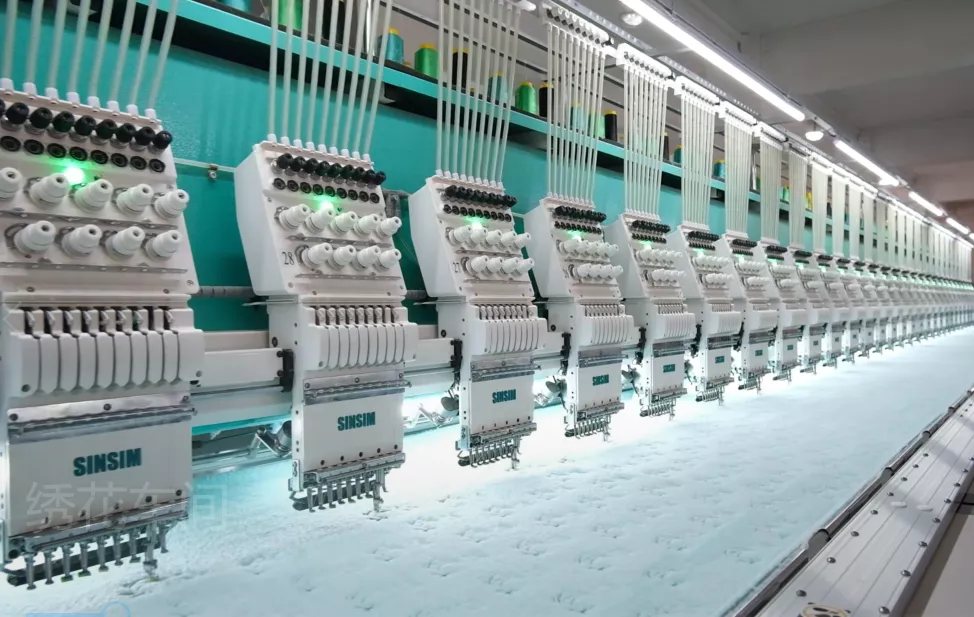
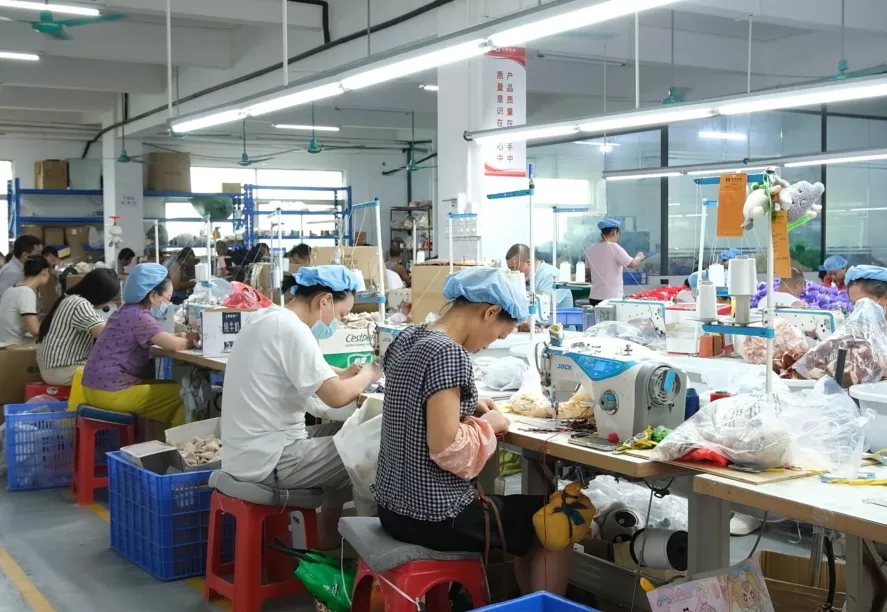
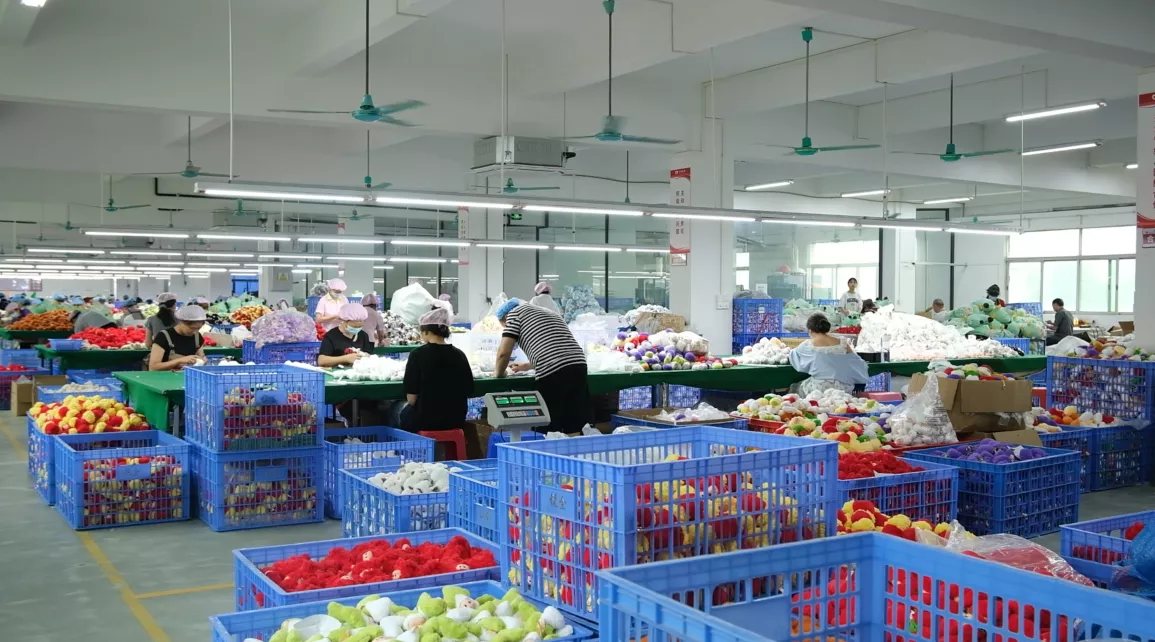
Guaila Toys produces through its own factory, Dongguan Yue Quan Toys Co., Ltd., with in-house pattern making, embroidery, sewing, assembly and a dedicated inspection team — not a broker subcontracting to unknown workshops.
Minimum order quantity (MOQ) for custom plush
MOQ is not an arbitrary hurdle — it is set by the economics of the line. Fabric mills sell plush cloth by the bolt, custom colours must be dyed in batches, embroidery machines need programmed setup, and a sewing line takes the same time to prepare whether it runs 100 or 1,000 pieces. Those fixed costs are spread across every unit, which is why small orders cost much more per piece.
| Order tier | Typical MOQ | What it allows | Indicative unit price* |
|---|---|---|---|
| Small-batch / semi-custom | 100–500 pcs | Stock fabric, simple embroidery or logo; best for tests and events | Highest — often US$5–10+ |
| Standard full custom | 500–1,000 pcs | Custom design, colours and accessories; the common first production run | ~US$7–12 for a 30 cm plush at 500 pcs |
| Retail / volume | 1,000–5,000 pcs | Custom packaging, multi-SKU lines, better line efficiency | ~US$3.40–6 |
| Mass / licensed program | 5,000+ pcs | Lowest unit cost; custom-dyed and moulded components | ~US$2.50–4.50 at 10,000+ pcs |
*Industry-typical reference ranges for a standard ~22–30 cm plush on FOB China terms, aggregated from manufacturer disclosures in 2025–2026; your quote depends on size, fabric, accessories, packaging and testing. We will quote your exact design and confirm the working MOQ.
If your quantity is below the standard threshold you still have options: pay a small-batch premium, run a prototype-only order for buyer presentations, crowdfunding or marketing photography, or consolidate colours across variants to share fabric and setup. Tell us your real quantity (a range is fine) and we will recommend the most cost-effective structure rather than forcing a one-size-fits-all MOQ.
How much do custom plush toys cost?
Quantity is the largest lever, but size, fabric, accessories, packaging and testing all move the price. The charts below show typical industry relationships for a standard character plush; treat them as planning figures, not a quotation.
Unit price vs. order quantity
Where the unit cost goes
Reference ranges aggregated from manufacturer disclosures, 2025–2026; excludes duties and destination freight. Materials typically account for 35–45% of cost and labour 25–35%.
One-time costs buyers often miss
| Item | Typical cost* | Note |
|---|---|---|
| Pattern making & first prototype | ~US$150–450 / design | Often partly or fully refundable against the bulk order |
| Custom Pantone colour match | ~US$80–200 / colour | Avoided by choosing stock colours |
| Mould / tooling (vinyl, PVC or silicone parts) | Project-based | Only for designer toys with moulded faces or parts |
| Third-party safety testing | ~US$300–1,200 / design | Required for US/EU retail; see the safety section |
| Packaging setup (print plates, films) | Varies | For color boxes, header cards and custom polybags |
*Industry reference figures for budgeting; actual costs are confirmed in your quotation.
How to compare two quotes fairly
A low headline price frequently excludes sampling, packaging, labels, testing or export cartons. Compare on the same basis: terms (EXW/FOB/CIF/DDP), size and weight, fabric and fill spec, accessories, packaging per piece, whether sample and testing fees are included, payment terms (commonly 30% deposit / 70% before shipment), and the stated AQL/inspection standard. Two factories quoting "the same plush" are rarely quoting the same product.
Lead times, shipping and seasonal deadlines
"Ships in four weeks" almost always means the sewing phase only. The real clock has three parts — sampling, mass production and freight — and most delays happen before sewing, while waiting on sample approval and custom fabric.
| Phase | Typical duration | Drivers |
|---|---|---|
| Sampling / prototype | 7–14 days; complex designs 2–4 weeks | Each revision round adds roughly 7–14 days |
| Mass production | 4–6 weeks (500–1,000 pcs); 6–8 weeks (1,000–5,000); 8–12 weeks (5,000+) | Sewing line capacity, custom dye and packaging |
| Freight | Air 7–15 days; ocean/rail 25–45 days | Destination port, customs and peak season |
| Door-to-door total | ~45–95 days | A typical 1,500-piece ocean order runs 60–75 days |
Plan around the Chinese New Year shutdown (usually mid-January through mid-February): production crossing that window can gain 3–4 weeks. Work backwards from your launch — for a Halloween or Christmas retail program, approve samples and place orders well before the northern-summer window, and earlier for ocean freight. We will give you a dated production schedule at order confirmation and flag any deadline risk on the first email rather than mid-production.
Safety, testing and certification for plush toys
If your plush is designed or intended primarily for children, it is a regulated toy in the US, EU and UK — not an ordinary soft good. The importer or brand named on the product is legally responsible for compliance, regardless of where it is made. Building the toy correctly from the start is far cheaper than failing a lab test or a customs inspection.
United States
- ASTM F963 (mandatory under CPSIA) — the Standard Consumer Safety Specification for Toy Safety, codified at 16 CFR Part 1250. Toys manufactured on or after 20 April 2024 must meet ASTM F963-23, covering material quality, small parts, sharp edges/points, wires, cords, labeling and more (CPSC toy-safety guidance; common import violations).
- Children's Product Certificate (CPC) — for toys for ages 12 and under, products must be tested by a CPSC-accepted third-party laboratory and certified in a written, English-language CPC citing the applicable rules (CPSC CPC guidance).
- Lead and phthalates — lead in surface coatings (16 CFR Part 1303, 90 ppm limit), total lead in accessible substrates (15 U.S.C. 1278a, 100 ppm), and restricted phthalates (16 CFR Part 1307).
- Small parts / choking — 16 CFR Part 1501 bans small parts for toys intended for children under 3, with prescribed warning labels where relevant — a key reason under-3 plush use embroidered faces and sealed, double-bagged pellets.
- Tracking labels and producer marking — permanent tracking information on the product and its packaging (15 U.S.C. 2063(a)(5)), plus the manufacturer or distributor's name and place of business.
- Pennsylvania Stuffed Toy registration — Pennsylvania separately requires registration and labeling for stuffed toys sold into the state; our factory holds a Pennsylvania Stuffed Toy Registration Certificate, a detail many overseas suppliers overlook.
European Union, United Kingdom and other markets
- EU: the Toy Safety Directive 2009/48/EC with CE marking, built on the EN 71 series — EN 71-1 (mechanical/physical), EN 71-2 (flammability) and EN 71-3 (migration of certain elements/heavy metals) — plus REACH chemical restrictions, an EU Declaration of Conformity and a technical file.
- UK: equivalent requirements with UKCA marking after placing on the GB market.
- California Prop 65 chemical warnings may apply for US distribution, and large retailers add their own audits and AQL inspection standards.
In practice, compliance shapes the design: embroidered rather than plastic eyes for under-3 lines, reinforced seams, fully contained pellet pouches, controlled plastic-bag thickness, no hazardous long cords, and correct permanent labels and age grades. We construct samples to pass the standards you need, advise which clauses apply to your age grade, and supply the documentation and test-ready units; third-party testing and the final CPC/DoC are issued in your name as the importer.
Our factory qualifications
Guaila Toys produces through Dongguan Yue Quan Toys Co., Ltd., an export plush factory independently audited and certified for the work we describe:
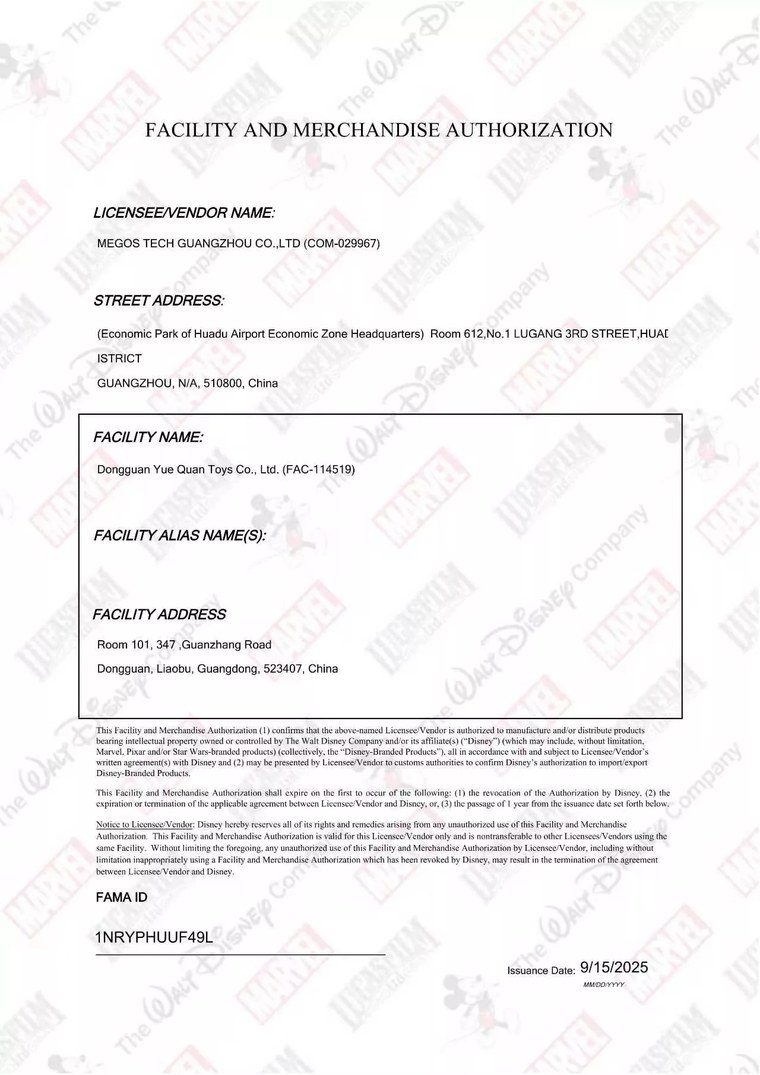
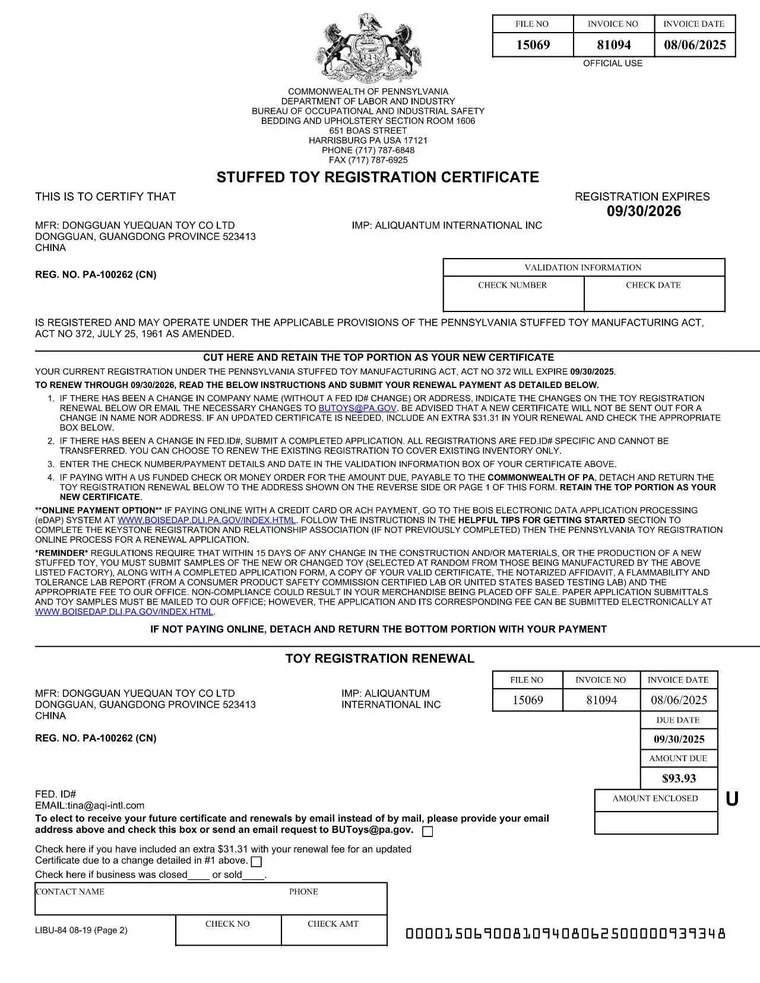
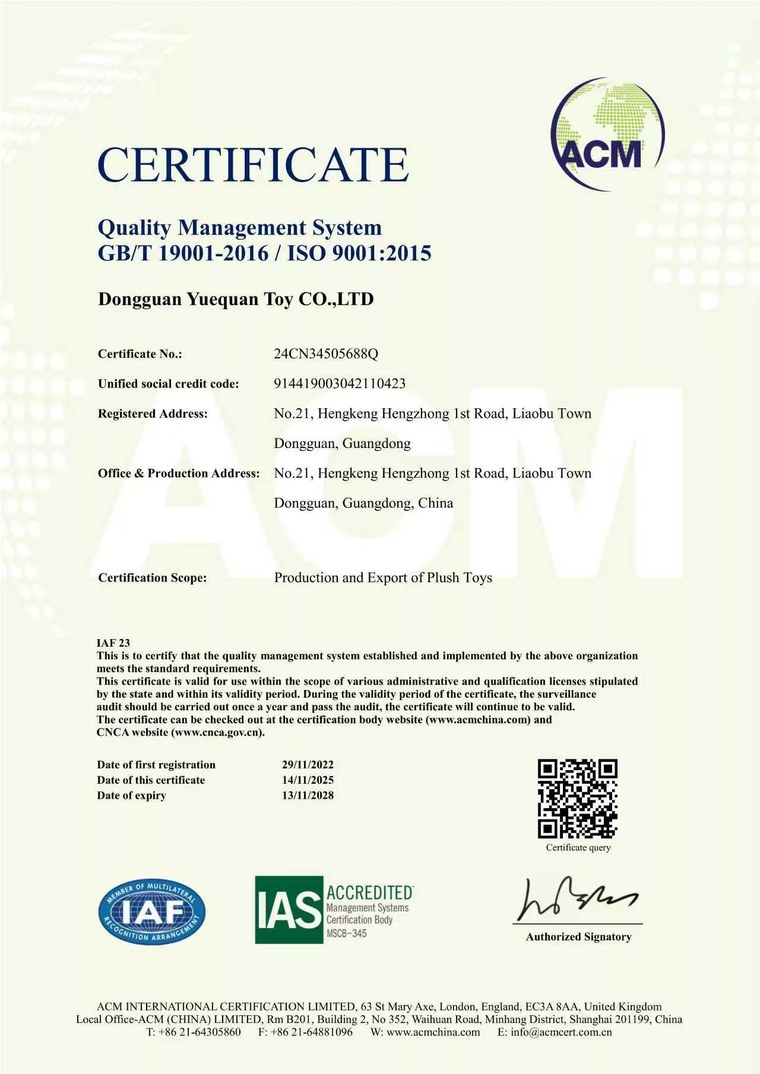
Certificates and audit reports are available on request as part of vendor onboarding. We support EN 71, ASTM F963, CPSIA and retailer-specific testing through accredited third-party laboratories.
OEM vs ODM: which custom plush service?
The two common factory relationships differ in who owns the design work. We provide both, and many projects blend them — for example, ODM development of a character followed by OEM mass production to an approved spec.
| OEM (made to your spec) | ODM (we help design & develop) | |
|---|---|---|
| Design | You supply finished artwork / tech pack / reference sample | We develop the design from your concept, sketch or brief |
| You provide | Dimensions, materials, Pantone, packaging, full specifications | Concept, mood references and product goals; we engineer the rest |
| Best for | Established brands and licensed programs with defined IP | Indie creators, startups and brands without in-house toy design |
| Development time | Shorter once specs are complete | Slightly longer, with collaborative sampling rounds |
| IP ownership | Wholly yours, by contract | Yours as agreed in the development contract |
IP protection and confidentiality
Your characters are the value of the project, so treat IP protection as a sourcing requirement, not an afterthought.
- Sign an NDA before sharing unreleased artwork. We are comfortable signing mutual NDAs and returning or holding files under agreed terms.
- Put ownership in writing. The contract should state who owns the artwork, sewing patterns, moulds and tooling, and define reuse limits.
- Prove you own licensed characters. Factories authorised for licensed merchandise (our facility holds Disney/Marvel FAMA) are required to verify brand authorization before production — be wary of any supplier happy to copy a famous character with no such check.
- Ask how your work is treated after delivery. Our policy is to never publish a client's project without written consent; every project shown on our website was shared with the client's approval. A factory that freely displays other buyers' unreleased designs will display yours the same way.
How to choose a custom plush manufacturer
The most important distinction is a direct factory versus a broker or trading company. Brokers can be useful for very small or mixed orders, but they add a margin and place a third party between you and the people actually cutting and sewing your product — which weakens quality control, communication speed and IP control.
| Question to ask | Direct factory | Broker / trader |
|---|---|---|
| Own workshop, pattern and embroidery? | Yes, in-house | Subcontracted; often unseen |
| Live factory photos, video or audit? | Provided freely | Generic or stock images |
| Certifications in the factory's own name? | Verifiable (FAMA, ISO, audits) | Borrowed or unavailable |
| Sample changes and QC handled by? | The same team that sews it | Passed through another party |
| Pricing transparency | One margin, direct | Layered mark-ups |
A 10-point factory checklist
- Owns the workshop, with in-house pattern making, embroidery and assembly lines.
- Provides named, verifiable certifications relevant to your market.
- Makes physical samples and supports reasonable revisions before bulk.
- States MOQ, sampling fees, lead time, terms and payment schedule in writing.
- Quotes packaging, labels, testing and inspection — not just the plush.
- Embroiders faces before assembly and inspects 100% of finished units.
- Signs NDAs and respects character licensing.
- Communicates in clear written English and answers technical questions directly.
- Shares a dated production schedule and flags risks early.
- Has a documented process for defects, spare parts and reorders.
Red flags that should make you walk away
"No MOQ and the lowest price you have seen" combined with no certificates; refusal to make or photograph a sample; no verifiable factory identity; quotes that omit testing and packaging; pressure to pay in full upfront; and a supplier that shows other clients' confidential designs as its portfolio. Any one of these is worth a second question; several together are worth a different supplier.
Start your custom plush project: the RFQ checklist
A complete first email gets you an accurate quote in days rather than a week of questions. Include as many of these as you can — gaps are fine, we will ask:
On receipt we review feasibility, recommend materials, confirm MOQ and sample/timeline, and quote — then develop the prototype for your approval before any bulk production begins.
Bring your character to life with a factory that builds it, not a broker
Guaila Toys is an OEM & ODM custom plush manufacturer for IP brands, creators, retailers and promotional teams, with our own export factory in Dongguan, in-house embroidery and 100% finished-unit inspection. Send your artwork for a feasibility review and quotation.
Custom plush toys FAQ
Can you make a plush toy from my drawing or character?
Yes. Most projects begin as a single illustration, character sheet, photo or AI concept. Our pattern maker translates it into fabric panels, and we produce a physical prototype you approve and revise before mass production. The closer your reference shows proportions, colours and details, the faster sampling goes.
How much does a custom plush toy cost?
It depends mainly on quantity, size and complexity. As an industry reference, a standard ~30 cm character is often around US$7–12 per piece at a 500-piece minimum and can fall to roughly US$2.50–4.50 at 10,000+ pieces, plus one-time sample, colour-matching and testing fees. We quote your exact design rather than giving a generic price.
What is your minimum order quantity (MOQ)?
Full custom production commonly starts around 500–1,000 pieces per design, while simpler or semi-custom items and prototypes can be made in smaller runs at higher unit cost. Send your quantity (a range is fine) and we will recommend the most economical structure; we support both small-batch development and large retail programs.
How long does sampling, production and shipping take?
A first sample usually takes 7–14 days (up to 2–4 weeks for complex, multi-material designs). Mass production runs roughly 4–8 weeks depending on quantity, and freight is 7–15 days by air or 25–45 days by ocean — about 45–95 days door to door in total. Avoid the Chinese New Year window and order seasonal programs early.
Do you handle ASTM F963, EN 71, CPSIA and CPC certification?
We engineer and construct toys to pass ASTM F963 (US), EN 71 (EU) and CPSIA requirements, and coordinate third-party testing through accredited laboratories. The CPC (US) or Declaration of Conformity (EU) is issued in the importer/brand's name; we provide the construction, documentation and test-ready samples needed. Our factory also holds Disney/Marvel FAMA, ISO 9001 and Pennsylvania stuffed-toy registration.
Can I order just one prototype or a very small batch?
Yes. Prototype-only orders are useful for crowdfunding pages, retail-buyer meetings and marketing photography, and small-batch production is available for tests and events. Unit costs are higher at low volume because pattern and setup costs are spread across fewer pieces.
Who owns the design, and do you sign an NDA?
Your artwork and IP remain yours, and ownership of patterns and tooling is set out in the contract. We sign mutual NDAs before sharing sensitive files, verify authorization for licensed characters, and never publish a client's project without written consent.
What file formats and information do you need to quote?
Any common image format (JPG, PNG, PDF, AI or PSD) works for the first review, with vector files preferred for logos and labels. Include size, quantity, target market and age group, colour references, accessories, packaging and deadline — the eight-point checklist above is all we need to start.
Can you make plush with vinyl faces, removable clothing or keychains?
Yes. Designer plush with moulded vinyl/PVC/silicone faces and hands, cotton dolls with removable costumes, and plush keychains and bag charms are core categories. Moulded parts require tooling and a slightly longer sampling stage, which we quote separately.
What are your payment and shipping terms?
Industry-standard terms are typically 30% deposit to begin production and 70% before shipment, with EXW, FOB, CIF or DDP available and air, ocean or express freight. We confirm terms on the proforma invoice and provide export documentation, packing lists and the records your customs process requires.